Short answer
Treat the machine price as the start of the budget. A practical launch reserve includes extraction, fire safety, fixtures, test material, packaging, software and enough working capital to absorb failed jobs and returns.
Worked example: a US laser business budget
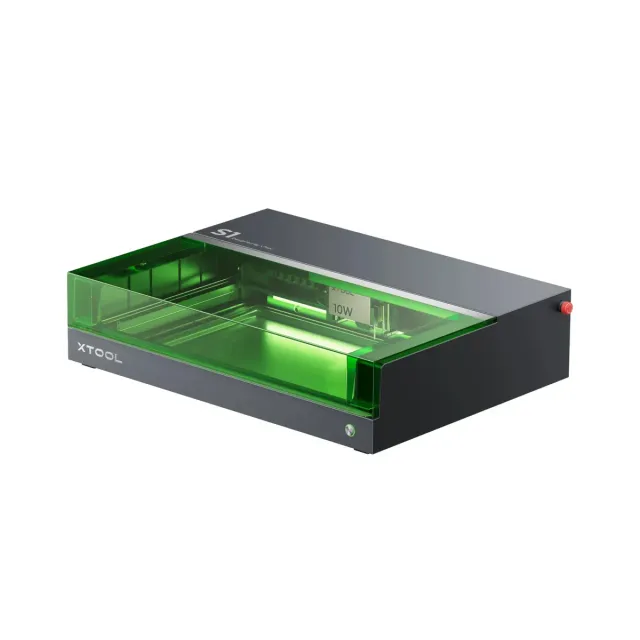
This US-dollar example assumes a solo operator making flat engraved goods with an xTool S1 40W, an existing computer and a suitable workspace. It assumes an approved outdoor exhaust route, no rotary attachment and no paid software. Confirm local requirements and the exact bundle before ordering; filtration or premises changes may increase the budget substantially.
Prepared 2026-11-02. The machine amount is the historical catalog reference, not a current offer. Every other amount is an editorial planning assumption, not a checked supplier price or a tax calculation.
xTool S1 40W research record · Official machine source · Record verification date: 2026-10-05
| Budget item | Planning amount |
|---|---|
| xTool S1 40W — historical reference | $2,199 |
| Outdoor extraction and ducting allowance | $250 |
| Work surface and fire-safety allowance | $150 |
| Fixtures and small tools allowance | $100 |
| Starter blanks and test material allowance | $200 |
| Packaging allowance | $100 |
| Shipping and sales-tax allowance | $300 |
| One-time setup subtotal | $3,299 |
| Working capital reserve | $500 |
| Illustrative opening cash | $3,799 |
The reserve is cash held for restocking, returns, failed jobs and early bills; it is not an extra machine expense. Do not count it again when paying those bills. The shipping and tax allowance must be replaced with the actual delivery quote and local tax; it does not imply a particular US sales-tax rate.
Recurring monthly planning costs
| Budget item | Planning amount |
|---|---|
| Software: bundled workflow assumed | $0 |
| Electricity allowance | $30 |
| Maintenance and consumables reserve | $50 |
| Administration and insurance allowance | $50 |
| Monthly overhead subtotal | $130 |
This overhead excludes rent, finance, business registration, paid advertising, owner wages and per-order materials, packaging, fees and shipping. Add any that apply. Insurance, permits and suitable extraction require local quotes; the allowance does not establish coverage or safety.
Example order economics
For an illustrative $30 order, assume $4 for a blank including scrap, $1 packaging, $2 selling and payment fees, $1 outbound-shipping subsidy and 30 minutes of labor valued at $20 per hour. The remaining $12 contributes to the monthly overhead and profit before income tax. These are assumptions, not measured production times, marketplace fee schedules or a profit forecast. Do not subtract the monthly overhead twice.
At those assumptions, 11 orders cover the $130 monthly overhead. Recovering the startup investment needs additional contribution and depends on actual sales, returns and labor. Use your own quotes and test a representative job before estimating payback.
One-time setup
Budget for the machine, exhaust or filtration, a fire-safe location, accessories, fixtures, measuring tools and initial materials. Shipping, duty and tax vary by market and are not included in catalog reference prices.
Recurring costs
Track material waste, filters, cleaning, replacement optics or tubes, packaging, design software, payment fees and labor. A fast machine can still be unprofitable when setup and finishing dominate each order.
Validate before scaling
Run representative products from artwork to packed order. Record job time, failure rate, consumables and selling fees before buying production accessories or a second machine.
- Calculate contribution margin per finished item.
- Keep prohibited-material and fire-response procedures visible.
- Do not promise throughput from manufacturer speed figures alone.